
Ilham Aliyev
We believe that trust needs to be earned over years, and it can be lost with one wrong step.
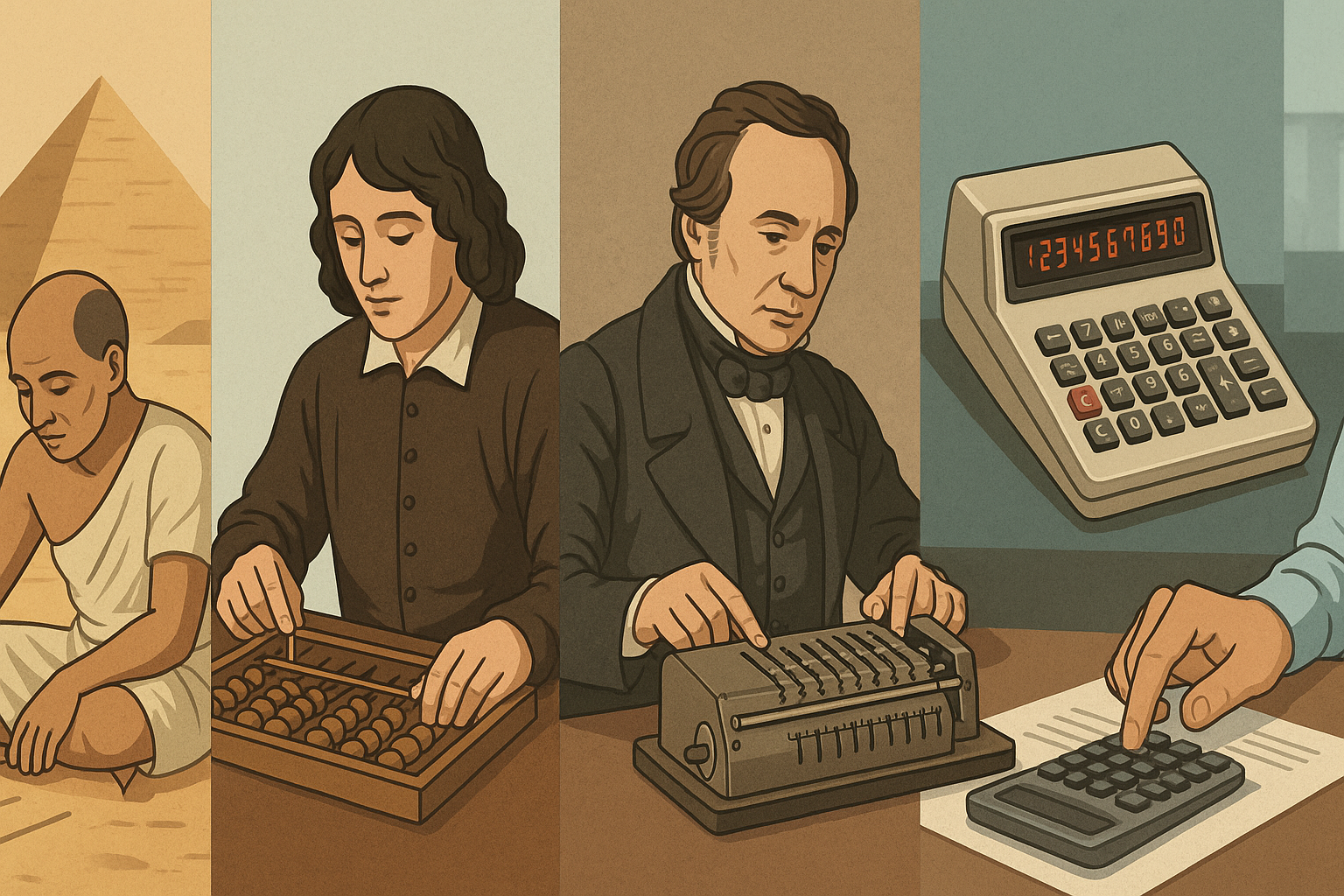
There was a time when the world relied solely on the memory of fingers and stones. In ancient marketplaces, merchants traded goods using finger counting, while Egyptians drew lines in the sand to learn how to count. But as time passed, human memory revealed its limits, errors increased, and humanity began pursuing the idea of “precise calculation.”
One of the earliest calculating tools in history was the abacus. Used around 2,300 years ago in Babylon and China, this simple device strengthened counting ability through physical touch. Abacuses allowed fast calculations without exhausting the human mind. Later, in the 16th century, John Napier introduced the concept of logarithms, which simplified computation by replacing multiplication and division with addition and subtraction. Yet the world was still far from the moment of “I press a button – the answer appears.”
If this feels primitive to you today, remember: there was no Excel, no electricity. People calculated manually using visual methods. Efficiency-wise, these techniques endured for thousands of years.
A true turning point began with Blaise Pascal. At just 19 years old, Pascal created the world’s first mechanical calculator—the “Pascaline”—in 1642 to ease the long and tiring calculation work of his father, who was a tax collector. This device performed addition and subtraction through gear wheels. If one wheel moved from 9 to 0, the next wheel automatically incremented by 1—forming the basis of the “carry-over” principle used in calculators today.
For its time, Pascal’s device was an engineering marvel. However, it did not become widespread as it was expensive and its mechanical subtleties were too complicated for the average user.
In short: if the calculator on your desk brings you peace today, its foundations were laid by Pascal centuries ago.
After Pascal, in 1673 Gottfried Leibniz created a stepped-drum calculator that could perform multiplication and division. In the 19th century, Charles Babbage proposed the idea of the “analytical engine”—a device considered the father of modern computers, capable of both computing and programming. These machines were large and noisy, but for the time, they brought a revolution to accounting. It took many years for such machines to enter practical use.
In the mid-20th century, a major leap occurred: electronic calculators appeared. In the 1960s, companies like Texas Instruments and Casio began producing the first portable calculators. Sharp introduced the world’s first portable model, the QT-8D. Soon after, Texas Instruments shook the market in 1972 with the TI-2500 Datamath. That same year, Hewlett-Packard launched the HP-35, the first scientific calculator—soon becoming indispensable in the world of science. Interestingly, back then such devices cost nearly as much as a television.
How long could accounting survive without calculators? In earlier times, accountants were trapped between tables, sums, erasers, and pencils. Every mistake required a new page, a new attempt, a new layer of exhaustion. But the presence of a calculator on the desk changed that reality. Manual calculation gave way to button-based calculation. Human mental energy finally shifted from computation to analysis.
Today’s calculators live on mobile phones, in the cloud, and even integrated with artificial intelligence. But at the beginning of this journey stands a young man thinking of his father.
The calculator is not merely a tool—it is a symbol of precision. Every button contains history: Pascal turning a manual wheel, Babbage dreaming through mechanical gears, and the quiet glow of electronic devices producing results. And today, with every “=” sign, we connect both to the past and the future. Even if technology evolves completely one day, believe me—there will always be a small buttoned calculator in an accountant’s bag.

.png)