
Ilham Aliyev
We believe that trust needs to be earned over years, and it can be lost with one wrong step.
History is not only the story of the victor — it is also the silent cry of suppressed intellects. We often focus on names like Edison, Newton, or Darwin. Yet throughout history, many crucial ideas, discoveries, and inventions were forgotten, misunderstood, delayed, or stolen — either because society was not ready for them, or because the fears and prohibitions of their time overshadowed their value.
In this article, our goal is to bring such hidden scientific contributions into the light. And not only physical inventions — but also the ideas that shaped finance, accounting, management, and technological systems yet never received the recognition they deserved in their own era. After all, the foundations of today’s ERP systems, financial automation, and AI-driven accounting were sometimes laid by brilliant minds hidden in the depths of medieval history.
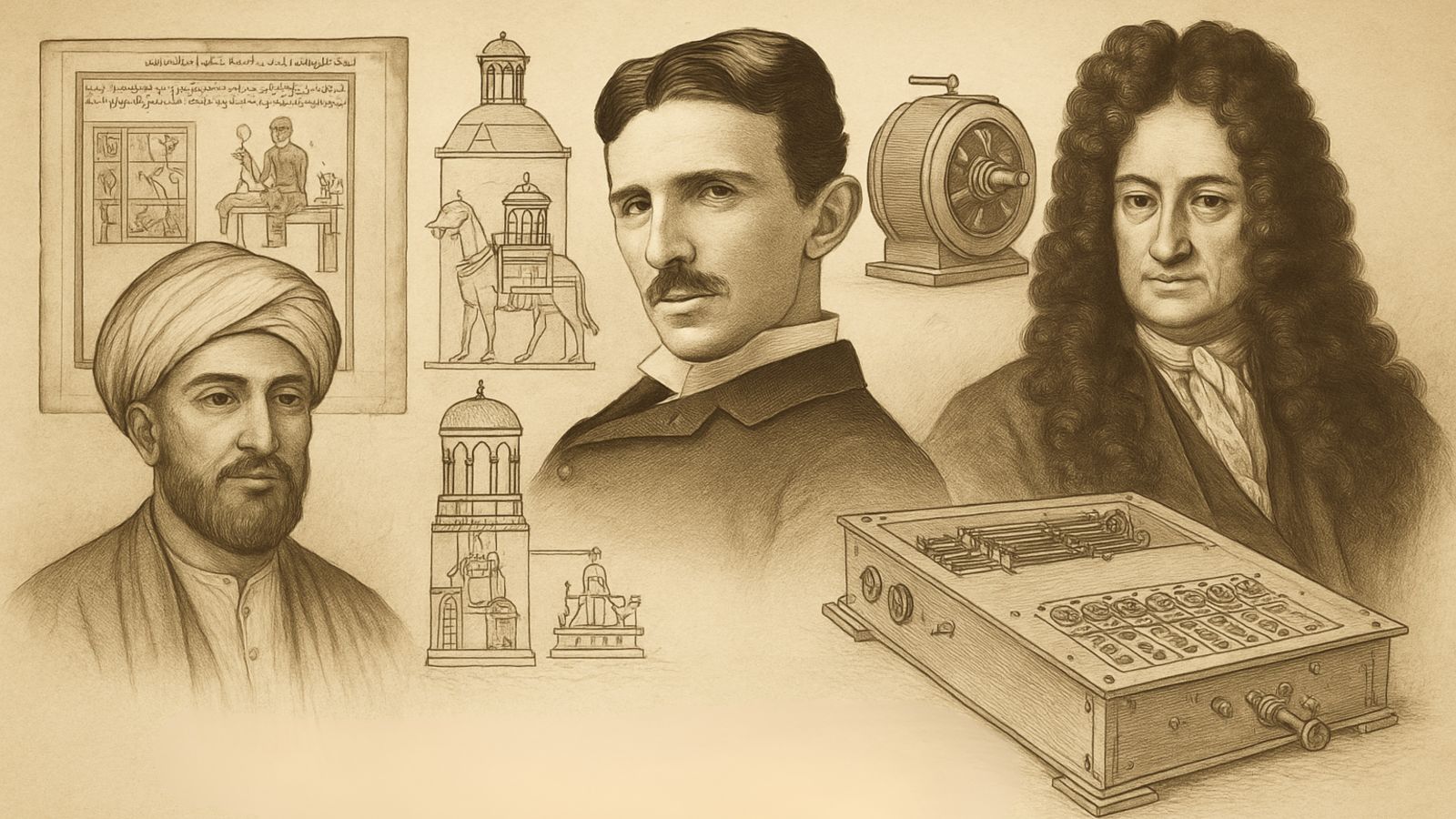
In the 13th century, the Mesopotamian scholar and engineer Al-Jazari revolutionized mechanical engineering and programmable devices. His detailed descriptions of water clocks, automated figurines, and flow-based control systems may look like toys at first glance, but in reality they were the earliest mathematical-mechanical models based on information flow.
For example, he designed a device that would automatically play music at a specific hour, set figures in motion, and then stop on its own. This was not merely a technical trick — it was logic-based programming.
The automatic calculations, calendar-based payment triggers, alert mechanisms, and resource-flow controls we use in modern accounting software are essentially the contemporary interpretations of this very logic. In other words, Al-Jazari introduced the conceptual foundation of ERP (Enterprise Resource Planning) centuries before the term existed — though his contributions were not fully appreciated until after the Industrial Revolution.
Nikola Tesla was not only a pioneer of electricity; he also explored cashless payments, remote control, and economic models based on the flow of energy. In the early 1900s, he envisioned a cashless economy and even proposed a concept of a “universal currency” built on information flow.
One of his assertions in 1904 was:
“Not money, but units of energy may become the basis of economic exchange.”
This aligns remarkably with today’s ideas of cryptocurrency, carbon credits, and digital payment systems.
Tesla was far ahead of his time and was not embraced by the financial elite. His approach to financial technologies began to materialize only a century later — in the form of blockchain, fintech, and token-based economies.
Gottfried Wilhelm Leibniz is typically associated with philosophy and mathematics, but in 1673 he built the Stepped Reckoner, one of the earliest mechanical calculators. It could perform addition, subtraction, multiplication, and division.
Modern accounting, tax reporting, and income-expense analysis are all digital descendants of such mechanical devices. However, Leibniz’s invention could not spread widely due to the technological limitations of his era and remained mostly as a concept. His work was continued only in the 19th century by Charles Babbage.
Throughout history, many inventions were hidden or silenced by religious, state, or power structures. Bruno was burned, Galileo was silenced, and Avicenna’s medical systems were kept concealed in Europe for centuries. Even in modern systems, innovations — such as tax transparency tools or digital traceability — are sometimes delayed by those who simply do not “want” them.
This reminds us that an idea alone is not enough — the era, context, and support mechanisms matter just as much.
Now we must ask ourselves:
Could a young researcher working in artificial intelligence today be another mind whose ideas may be “forgotten in the future’s past,” simply because they are unrecognized now?
Perhaps an algorithm designed to enhance tax transparency or an AI-based solution for public financial management is being pushed aside just because it is not yet understood.
How much do we truly see — and how much do we reject out of fear?
Forgotten inventions are not just historical anecdotes — they reveal systemic delays, the moments when humanity surrendered to fear, and what we lose when we are not ready to change.
Al-Jazari, Tesla, Leibniz and many others remind us of one truth:
If we fail to value an idea in time, it becomes the wealth of another nation — or another century.
In today’s world — especially in an era of rapidly evolving financial and tax technologies — perhaps the greatest invention is quietly waiting on the sidelines, overlooked and unheard.

.png)