
Ilham Aliyev
We believe that trust needs to be earned over years, and it can be lost with one wrong step.
— A story of success broken apart and rebuilt —
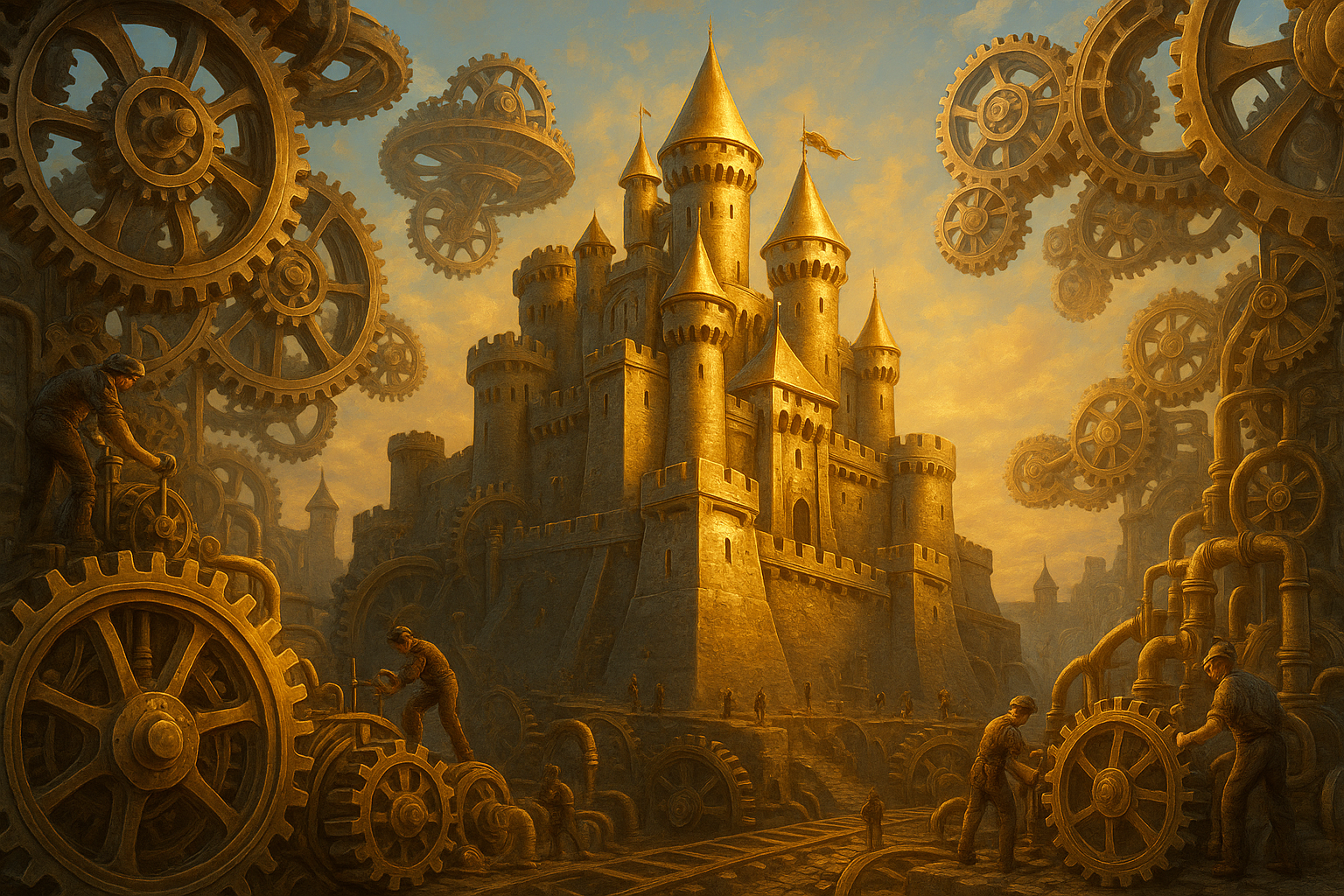
Once upon a time, in a land filled with mechanisms, there stood a place known as the Kingdom of Mechanisms. Here, everything — the air lanterns, the water lines, even the sunrise itself — was controlled by interconnected gears.
At the center of the kingdom stood a towering Pillar of Success. At its peak was the Main Mechanism, a system that sent signals across all gears, ensuring perfect order, prosperity, and stability.
But over time, some gears were left un-oiled, tiny teeth loosened, workers grew weary, and managers became careless. No one noticed a certain gear slowing down, or another being overloaded. And one day…
the Main Mechanism stopped.
The Pillar of Success went dark.
The kingdom froze.
As if nothing had ever moved, everything suddenly came to a halt.
With the gears stopped, the very concept of time vanished. Workers no longer knew when tasks should be completed or where resources should be directed. The financial gears faltered — without a unified budget, decisions became chaotic. Some towns ran out of supplies due to poor distribution, while others were criticized for storing too much.
There was an old master in the kingdom — a mechanic named Chronos. He quietly climbed the tower, looked at the dust-covered gears, and said:
“This kingdom was not run by gears, but by responsibility.
Every detail, no matter how small, was accountable to the system.
Now each one must not only oil its own tooth — but understand the entire mechanism.”
Chronos disassembled the Main Mechanism. Inside, he found a single, crucial connecting ring — a tiny part that had carried the weight of the entire system yet had never been inspected, never appreciated.
Chronos, along with a group of young engineers and managers, rebuilt the system. This time, they changed not only the technical structure but also the philosophy of management.
The role of every gear was documented.
Measurable indicators were introduced for workflow.
A monitoring panel was created for small gears, and an audit system for large ones.
Time became the official currency — any task not completed on time carried a cost.
Every part of the system now reported, was analyzed, and evaluated.
When the Pillar of Success lit up once again, it was no longer just a mechanism — it had become a system enriched with strategy, values, and learned lessons.
The Kingdom of Mechanisms was no longer merely a pile of working gears — it had transformed into an ecosystem that thought in numbers but breathed with people. And this was a story every business needed to learn:
“Success is not merely working — it is thinking in systems and turning together.”

.png)